
What's After Quadrillion: A Clear Guide To The Next Huge-Number Names

What’s After Quadrillion? It’s a natural question for anyone dealing with large numbers, from scientists counting atoms to economists projecting global scales. This guide presents a clear path to the next huge-number names, explains how they’re formed, and shows where they appear in real-world measurements.
In plain terms, the naming pattern after quadrillion follows a Latin-rooted suffix -illion, with prefixes that steadily ascend from quint- onward. This article helps you map the next steps, how to read them, and practical tips for remembering them.
Understanding the naming sequence after quadrillion
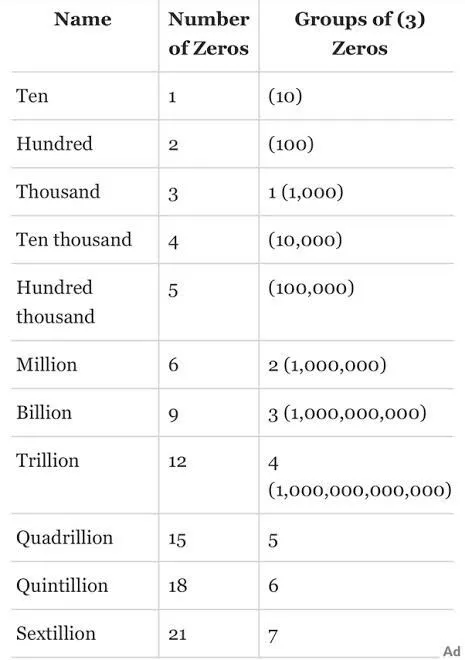
For the short-scale system commonly used in English, the sequence proceeds quintillion, sextillion, septillion, octillion, nonillion, decillion, and so on. Each step adds a factor of 1,000. In the long-scale tradition used in a few regions, the same suffix chain exists but the actual numeric size shifts due to different step definitions. Being explicit about the scale you’re using avoids miscommunication.
Key Points
- The next names after quadrillion follow the -illion suffix with Latin prefixes such as quint-, sext-, sept-, oct-, and non- before continuing to decillion and beyond.
- Each step in the short-scale system multiplies the previous value by 1,000, so quintillion is 1,000 quadrillions, sextillion is 1,000 quintillions, etc.
- Long-scale usage shifts the exact exponent size, so be explicit about the convention when communicating large figures in different regions.
- In practice, many people prefer scientific notation (e.g., 6.02 × 10^23) or SI prefixes (k, M, G, T, P, E, Z, Y) for clarity beyond a certain threshold.
- Clear labeling is essential in international contexts to prevent errors in finance, science, and technology projects.
In the short-scale system, the progression from quadrillion moves through quintillion, sextillion, septillion, octillion, nonillion, and decillion, with the pattern continuing indefinitely for larger calculations. The long-scale system uses a different set of sizes, so it’s helpful to specify which convention you’re using in any written material that involves large numbers.
Tip: When expressing extremely large figures in writing, combine the name with a numeric form or scientific notation to keep your meaning crystal clear. This is especially true in technical reports, databases, and educational materials where precision matters.
What comes after quadrillion in the most common naming system?
+The next names are quintillion, sextillion, septillion, octillion, nonillion, and decillion. Each step increases the scale by a factor of 1,000 in the short-scale system, with further names continuing beyond that as needed.
Do different regions use different conventions for these names?
+Yes. The short-scale system (used in many English-speaking countries) names after quadrillion progress quintillion, sextillion, septillion, etc., each 1,000 times the previous. Some regions historically used the long-scale system, where the numeric jumps between names are organized differently. When working internationally, specify the convention to avoid confusion.
How are these names used in real-world contexts?
+In science, finance, and computing, large numbers are often expressed with scientific notation or SI prefixes to keep things readable. For example, Avogadro’s number is about 6.022 × 10^23, which translates to a size that sits well beyond quadrillion and into the sextillions region depending on the naming convention. The goal is clarity and precision rather than long-winded words.
Is there an official standard for naming these big numbers?
+There isn’t a single global authority that prescribes every name beyond a certain point. The suffix -illion and many prefixes are widely recognized, but exact usage can vary by region and context. Dictionaries, mathematical references, and scientific style guides typically agree on the common ladder of quintillion, sextillion, septillion, and so on, while noting regional differences between short-scale and long-scale systems.