
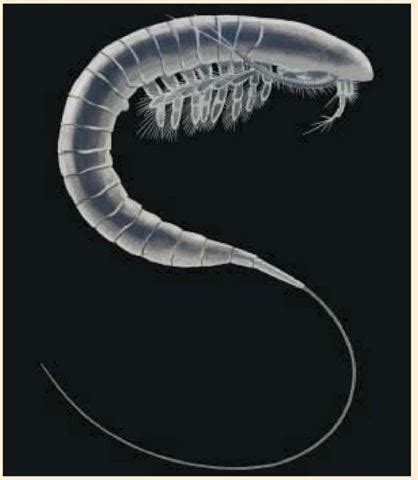
What Is Cephalocarida? This question opens a look at one of the smallest but most telling groups in the crustacean family. Cephalocarida are tiny, sediment-dwelling crustaceans that offer a compact blueprint of crustacean life. In this article we explore what cephalocarids are, where they live, what they look like, and why they matter to our understanding of crustacean evolution.
As a group, Cephalocarida are among the most ancient crustacean lineages, and their simple body plan highlights early design principles that later taxa built upon. Their diminutive size and quiet lifestyle in marine sediments make them easy to overlook, yet they illuminate fundamental aspects of crustacean biology.
Key Points
- Cephalocarida are an early-diverging crustacean order with a compact body plan that hints at ancestral layout.
- They live in marine sediments worldwide, often in quiet, shallow-to-middle depth habitats.
- Their limb arrangement is simplified for a slow, substrate-bound lifestyle rather than active swimming.
- Direct development keeps life cycles compact within their sediment niches.
- Studying cephalocarids helps map early crustacean features and informs how later groups evolved.
Taxonomy and Anatomy
Cephalocarida represent one of the earliest branches within Crustacea. They have a simple, compact body with a basic arrangement of limbs that favors a quiet, sediment-associated lifestyle. The head and thorax are broadly combined, and the abdomen is short, offering a streamlined form that researchers study to understand primitive crustacean design.
Habitat and Ecology
In the wild, cephalocarids are found in marine sediments around the world. They contribute to the microbial and detrital processing that keeps sediment ecosystems healthy. Their cryptic lifestyle means they rarely surface, so researchers rely on sediment sampling and microcosms to study them.
Life Cycle and Reproduction
Their reproductive strategy favors direct development, with juveniles resembling small adults. This approach suits a sedentary lifestyle and helps populations persist in patchy sediment environments.
Evolutionary Significance
As a primitive crustacean group, Cephalocarida provide a window into early crustacean life. What Is Cephalocarida illustrates an early body plan that informs how later crustaceans evolved features such as more complex limb specialization and segmentation patterns.
What makes Cephalocarida different from other crustaceans?
+Cephalocarida are exceptionally small and have a comparatively simple body plan with fewer specialized limbs than many crustaceans. This streamlined design reflects an ancient, sediment-dwelling lifestyle and provides a baseline for comparing more derived crustaceans.
<div class="faq-item">
  <div class="faq-question">
    <h3>Where can Cephalocarida be found?</h3>
    <span class="faq-toggle">+</span>
  </div>
  <div class="faq-answer">
    <p>They inhabit marine sediments worldwide, from coastal zones to subtler subtidal areas. Collecting them usually involves careful sediment sampling and microscopic examination.</p>
  </div>
</div>

<div class="faq-item">
  <div class="faq-question">
    <h3>Do Cephalocarida have a larval stage?</h3>
    <span class="faq-toggle">+</span>
  </div>
  <div class="faq-answer">
    <p>No long free-swimming larval stages are typical for Cephalocarida. They exhibit direct development, with juveniles that resemble small adults, which suits their sediment-based lifestyle.</p>
  </div>
</div>

<div class="faq-item">
  <div class="faq-question">
    <h3>Why are Cephalocarida important to scientists studying crustacean evolution?</h3>
    <span class="faq-toggle">+</span>
  </div>
  <div class="faq-answer">
    <p>They act as a living window into early crustacean design. By studying their anatomy and genetics, researchers can infer how key features such as segmentation and limb arrangement emerged in the crustacean lineage.</p>
  </div>
</div>

<div class="faq-item">
  <div class="faq-question">
    <h3>How can researchers observe Cephalocarida in the field or lab?</h3>
    <span class="faq-toggle">+</span>
  </div>
  <div class="faq-answer">
    <p>Observations typically rely on sediment sampling, sieving, and microscopic examination. In the lab, microcosms and careful extraction help researchers study their behavior and morphology without harming these tiny creatures.</p>
  </div>
</div>